
Stop Losing Money to Bad Wi-Fi: How Business-Grade Networking Gear Changes the Game
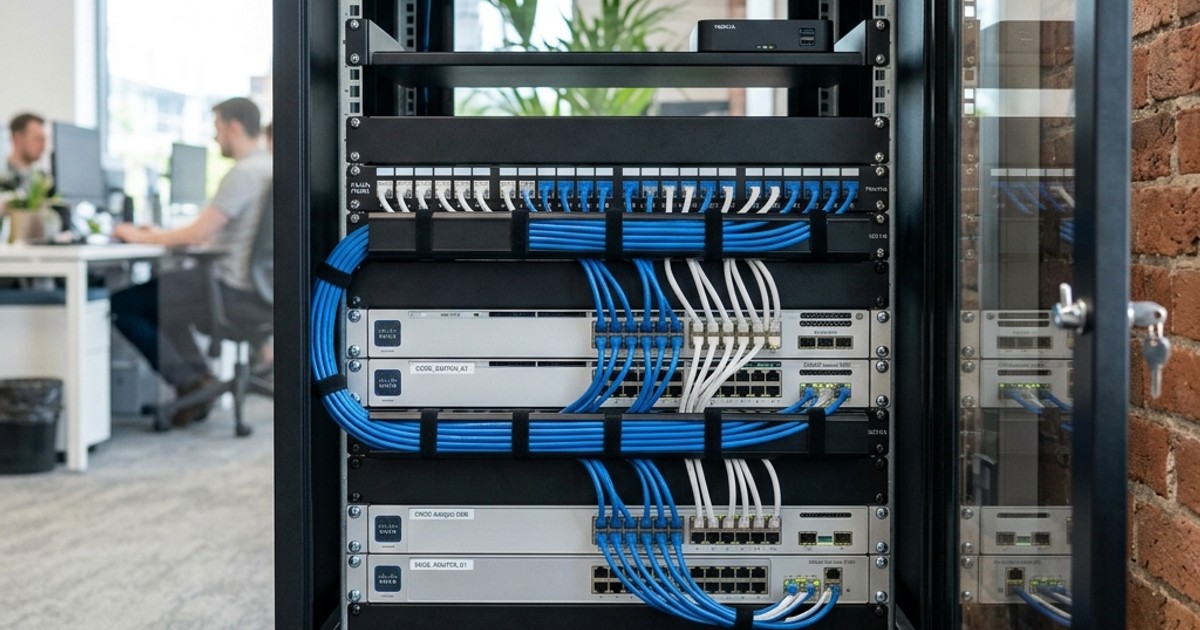
Is slow, drop-prone Wi-Fi quietly eating away at your company's productivity? Discover why consumer routers fail in business settings and how enterprise networking changes the game.
For a modern business, your wireless network is just as critical to operations as electricity or running water. Yet, in many growing offices, the entire technology stack is balanced on a fragile foundation: a $150 consumer-grade wireless router tucked in a dusty corner or closet.
When employees experience dropped Zoom calls, sluggish database syncs, or random disconnects, most business owners treat it as a minor annoyance. But if you calculate the actual financial cost of network downtime, the numbers tell a very different story.
Treating your network as a cheap commodity is costing you money. Here is why consumer-grade routers fail in a professional office environment, and how upgrading to business-grade infrastructure completely changes the game.
The Hidden Cost of Bad Wi-Fi
Let’s look at the cold, hard numbers. Suppose you run a small business with 20 employees, each earning an average of $35 per hour. If your network experiences just 15 minutes of slow performance or dropouts per day, here is what that looks like:
- Daily lost productivity: 5 hours of total team time
- Daily financial loss: $175
- Monthly financial loss: $3,500
- Annual financial loss: $42,000
This doesn't account for lost revenue from dropped sales calls, frustrated clients who can't get through, or point-of-sale systems failing to process credit cards. Suddenly, that "cheap" consumer router looks like an incredibly expensive bottleneck.
Why Consumer-Grade Routers Fail in the Office
Many business owners assume a router is a router. However, consumer gear (like the boxes you get from Best Buy or rent from your ISP) is designed for a completely different environment.
1. Device Overload (The Density Problem)
A typical household might have 10 to 15 connected devices (smartphones, streaming sticks, and a couple of laptops). In a professional office, that density skyrockets. Every single employee brings a laptop, a smartphone, and perhaps a tablet. Add in wireless printers, VoIP desk phones, smart TVs in conference rooms, and smart thermostats, and a small office of 15 people can easily surpass 60 active network clients. Consumer routers simply do not have the CPU power or memory to handle high-density client routing, leading to frequent crashes and restarts.
2. Lack of Centralized Handoff
If your office is larger than a small one-room suite, you likely need multiple wireless access points (APs) to cover the physical space. Consumer range extenders or basic mesh systems handle handoff poorly. As you walk from your desk to a conference room, your laptop will cling to the distant, weak AP rather than seamlessly transitioning to the closer one. This causes dropped calls and frozen screens.
3. Non-Existent Traffic Prioritization
On a consumer router, a video conference has the exact same network priority as a massive file download or someone streaming a video in the breakroom. Without Quality of Service (QoS) configurations, your critical business systems are constantly fighting for bandwidth against non-essential traffic.
How Business-Grade Networking Gear Changes the Game
Upgrading to enterprise-class networking hardware—like UniFi security gateways, managed switches, and discrete wireless access points—transforms your network from a liability into a strategic asset.
1. Active Traffic Prioritization (QoS)
With professional managed hardware, we configure Quality of Service (QoS) rules to guarantee that your most critical business systems—such as your VoIP phone systems and cloud database syncs—always receive prioritized, dedicated bandwidth. Even if someone is downloading a huge file in the next room, your customer calls remain crystal clear.
2. Seamless Enterprise Handoff (Fast Roaming)
Business-grade wireless access points work together as a single cohesive unit managed by a centralized software controller. By utilizing fast roaming protocols (like 802.11r), the network dynamically hands off your device to the strongest access point in real-time as you move around the office, ensuring 100% continuous connectivity without drops.
3. Isolated Guest Networks & VLAN Security
Customer data and financial records must be kept completely secure. With enterprise hardware, we create virtual local area networks (VLANs). This allows us to broadcast a secure network for your staff and an entirely isolated, firewalled guest network for visitors, preventing external guests from ever having visibility into your internal files or servers.
4. Proactive 24/7 Active Monitoring
Perhaps the biggest difference is how we maintain it. When a consumer router goes down, you have to physically walk over, unplug it, wait 30 seconds, and hope for the best. With a managed networking service from eSmith IT, your infrastructure is actively monitored 24/7. Our advanced alerting systems notify our engineering team if an access point drops or a switch port reports errors. In most cases, we diagnose and resolve the issue remotely before your team even notices a slowdown.
Build a Flawless Network Infrastructure Today
Your business deserves network infrastructure that is fast, secure, and completely invisible. You shouldn't have to think about your Wi-Fi—it should just work.
At eSmith IT Consulting, we design, deploy, and actively manage commercial-grade networking solutions tailored specifically for growing teams. We eliminate dead zones, protect your data, and optimize your bandwidth so you can stop losing productivity to dropouts.
Ready to stop losing money to bad Wi-Fi? Learn more about our comprehensive Managed IT Support and Services to see how we keep local North Carolina businesses running flawlessly, or connect with us today to schedule your free network assessment.

About the Author
Kevin Smith
With over 25 years of verifiable IT experience across the Carolinas, Kevin Smith is an industry-recognized expert in Microsoft Cloud deployment, disaster recovery, and HIPAA compliance. As the President of eSmith IT Consulting, establishing secure enterprise infrastructure isn't just theory—it's his daily practice.