
IT Compliance Guide for Dental and Medical Clinics in NC: HIPAA & Data Security
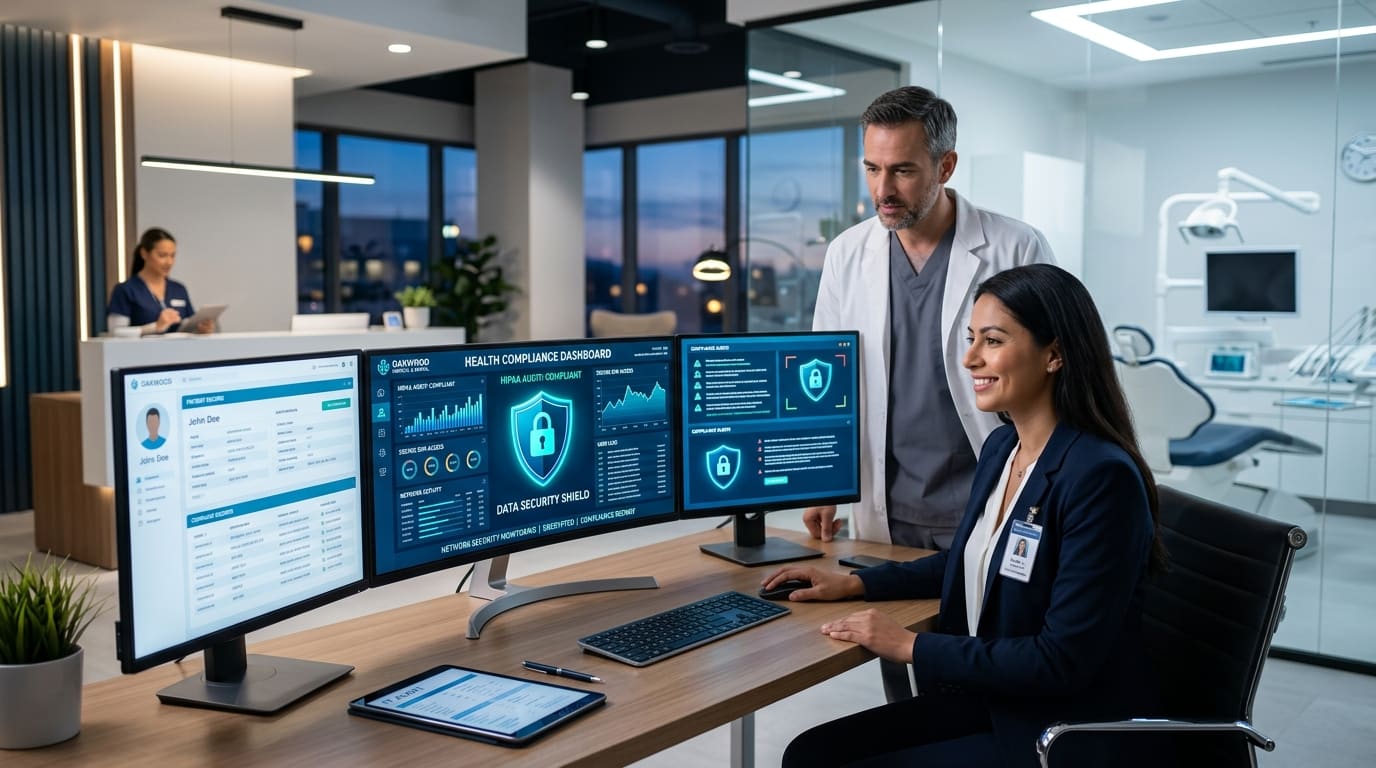
A complete HIPAA IT compliance guide for North Carolina medical and dental practices. Learn how to secure ePHI, segment medical networks, enforce BAAs, and pass audits.
Independent dental practices, specialty medical clinics, and multi-location healthcare providers across North Carolina operate under some of the strictest regulatory conditions in business today. From bustling multi-chair dental clinics in Charlotte’s SouthPark and Ballantyne to medical groups throughout Raleigh, Greensboro, and Asheville, healthcare providers handle large volumes of electronic Protected Health Information (ePHI) every single day.
However, healthcare technology infrastructure has grown increasingly complex. Today’s modern practice relies on cloud-based Practice Management Systems (PMS), digital imaging software, intraoral scanners, 3D CBCT imaging, telemetry devices, remote patient portals, and telehealth tools. While these innovations streamline patient care and operational efficiency, they also dramatically expand your cyber attack surface.
For North Carolina dental and medical clinics, HIPAA compliance is not a static one-time checklist—it is an active, technical safeguard requirement. In this comprehensive guide, we unpack the technical mandates of the HIPAA Security Rule, North Carolina state privacy regulations, Business Associate Agreement (BAA) requirements, and how to build a defensible, audit-ready IT infrastructure.
Why Healthcare Clinics Are Prime Targets for Cybercriminals and Regulators
Healthcare data remains the most valuable commodity on the dark web, commanding up to 10 to 40 times more than stolen credit card numbers. A single patient record contains Social Security numbers, dates of birth, health insurance details, financial records, and medical histories—everything required for persistent identity theft and fraudulent billing.
Furthermore, cybercriminals recognize that medical and dental practices cannot afford downtime. A ransomware infection that locks patient charts, digital X-rays, or scheduling databases immediately halts clinical care, forcing practice managers into high-stakes crises.
At the same time, regulatory oversight from the U.S. Department of Health and Human Services (HHS) Office for Civil Rights (OCR) has intensified. Settlements and financial penalties for HIPAA Security Rule non-compliance—particularly for failing to conduct an annual Security Risk Analysis (SRA) or lacking technical access controls—frequently range from tens of thousands to millions of dollars.
The HIPAA Security Rule: Technical Safeguards Every NC Clinic Must Enforce
The HIPAA Security Rule (45 CFR Part 160 and Part 164, Subparts A and C) establishes national standards to protect individuals' ePHI created, received, used, or maintained by a covered entity. The rule splits compliance into Administrative, Physical, and Technical Safeguards.
While administrative policies dictate rules on paper, Technical Safeguards represent the technology controls enforced at the network, server, device, and application levels.
Here are the four key technical safeguard pillars every North Carolina medical and dental clinic must implement:
1. Access Control & Identity Management (45 CFR § 164.312(a))
Access controls ensure that only authorized personnel can access ePHI based strictly on their job roles.
- Unique User Identifiers: Generic office logins (e.g., "frontdesk" or "hygiene1") violate HIPAA mandates. Every employee—from front-desk schedulers to associate dentists and head surgeons—must have a unique username and credential.
- Role-Based Access Control (RBAC): Billing staff should not have access to full diagnostic imaging files or clinical notes unless required for their duties. Hygienists and medical assistants should only access records pertinent to their scheduled patients.
- Multi-Factor Authentication (MFA): MFA must be enforced on all cloud platforms (Microsoft 365, EHR portals, digital chart repositories) and remote access points (VPNs or RDP sessions).
- Automatic Logoff: Workstations in patient treatment rooms, hygiene bays, or check-out desks must automatically lock after a brief period of inactivity (typically 3 to 5 minutes) to prevent unauthorized viewing by patients or visitors.
2. Audit Controls & Centralized Logging (45 CFR § 164.312(b))
Covered entities must implement hardware, software, and procedural mechanisms that record and examine activity in systems containing or utilizing ePHI.
- EHR/PMS Audit Logs: Your practice management software (e.g., Dentrix, Eaglesoft, Open Dental, eClinicalWorks, Epic, AthenaHealth) must capture log events showing who opened, modified, exported, or deleted a patient chart.
- Network Sign-in & Domain Logs: Active Directory or Microsoft Entra ID logs must record login attempts, password changes, and privilege escalations.
- Log Retention & Proactive Review: Collecting logs is insufficient if no one reviews them. Systems should aggregate logs centrally, maintaining audit trails for at least 6 years to satisfy HIPAA documentation retention requirements.
3. Integrity Controls & End-to-End Data Encryption (45 CFR § 164.312(c) & (e))
Data encryption protects patient information both at rest (stored on hard drives and servers) and in transit (sent across local networks or the internet).
- Encryption at Rest: All server storage, local workstation NVMe/SSDs, backup drives, and laptop hard drives must utilize full-disk encryption (such as BitLocker with TPM 2.0 or AES-256 Bit Encryption).
- Encryption in Transit: Any transmission of ePHI over public networks must use secure protocols (TLS 1.3). Standard email is inherently unencrypted; sending patient records, referrals, or X-rays via standard unencrypted email is an explicit HIPAA violation. Secure encrypted email portals or S/MIME encryption must be utilized.
4. Network Segmentation & Medical Device Security
Modern dental and medical practices utilize specialized network-connected hardware:
- Dental Imaging Equipment: Digital X-ray sensors, 3D CBCT scanners, intraoral cameras, and CAD/CAM milling machines.
- Medical Equipment: Telemetry monitors, digital vitals carts, smart IV pumps, and lab equipment.
If these devices share the same network subnet as employee web-browsing workstations or patient guest Wi-Fi, a breach on one office PC allows attackers to pivot directly into your diagnostic hardware or server infrastructure.
Best Practice: Clinics must implement firewalls with virtual local area networks (VLANs) to isolate medical/dental equipment, administrative workstations, server infrastructure, and guest Wi-Fi into separate, encrypted network segments.
North Carolina Specific Compliance & Breach Notification Laws
In addition to federal HIPAA mandates, North Carolina healthcare practices must comply with state privacy and security statutes.
1. North Carolina Identity Theft Protection Act (N.C. Gen. Stat. § 75-60 et seq.)
North Carolina law places strict duties on businesses holding personal identifying information (PII), which includes Social Security numbers, driver's license numbers, and financial account credentials. The statute requires practices to implement reasonable security measures to protect PII from unauthorized disclosure and mandates safe disposal of electronic media and physical records.
2. Dual Breach Notification Duties
If a security incident or ransomware attack compromises patient data in North Carolina, the clinic must comply with two separate notification timelines:
- Federal HIPAA Breach Notification Rule: Notice to affected individuals and HHS OCR within 60 days of discovery (or immediately if over 500 records are affected).
- North Carolina Attorney General Notification: Under N.C. Gen. Stat. § 75-65, businesses must notify the Consumer Protection Division of the North Carolina Attorney General's Office without unreasonable delay when personal information is breached.
3. NC State Medical & Dental Board Records Requirements
Both the North Carolina Medical Board (NCMB) and the North Carolina State Board of Dental Examiners (NCSBDE) publish position statements regarding patient record retention, confidentiality, and electronic records management. Clinics must maintain adult patient records for minimum required periods (typically 6 to 10 years depending on specialty and minor status) while ensuring that data integrity and access controls remain fully functional throughout the retention lifecycle.
Business Associate Agreements (BAAs): Avoiding the Hidden Fine Trap
Under HIPAA, any third-party vendor that creates, receives, maintains, or transmits ePHI on behalf of your practice is classified as a Business Associate (BA).
Common Vendors Requiring a Signed BAA:
- Managed Service Providers (MSPs) and IT Support firms
- Cloud backup and disaster recovery vendors
- Cloud-hosted practice management / EHR software providers
- Medical billing, coding, and collection agencies
- VoIP phone service providers handling patient voicemail or call recordings
- Encrypted email and cloud storage providers
The Dangerous BAA Trap
Many clinics mistakenly assume that using a well-known cloud service automatically makes them compliant. However, if you use consumer-grade cloud storage (like personal Dropbox or free Google Drive) or standard unencrypted email without an executed BAA in place, your practice is in direct violation of HIPAA—regardless of how secure the underlying vendor's servers might be.
At eSmith IT Consulting, we execute comprehensive Business Associate Agreements with all our healthcare clients, explicitly binding our operations and technical support services to HIPAA standards.
Building an Audit-Ready Practice: SRAs, Backups, and Disaster Recovery
When an OCR auditor or cyber insurance risk assessor reviews your practice, they look for documented proof of technical governance.
1. Mandatory Annual Security Risk Analysis (SRA)
Conducting an annual SRA (45 CFR § 164.308(a)(1)(ii)(A)) is a mandatory requirement under HIPAA. An SRA is not a quick 10-question paper survey. It is a comprehensive technical assessment that evaluates:
- All assets storing or processing ePHI (servers, PCs, tablets, imaging units, backups).
- Vulnerability scans of internal networks and external firewalls.
- Review of password policies, administrative rights, and MFA enforcement.
- Verification of physical room security, server lockups, and cable management.
2. The 3-2-1-1 Immutable Backup Strategy for EHR Data
Patient chart databases (Dentrix, Eaglesoft, Open Dental, eClinicalWorks, etc.) require near-zero data loss tolerances. We implement an audit-defensible 3-2-1-1 backup model:
- 3 copies of your data (Primary production database + 2 backups).
- 2 different media types (Local flash storage + secure cloud vault).
- 1 copy stored offsite.
- 1 copy stored in an immutable, air-gapped environment that cannot be deleted, modified, or encrypted by ransomware.
3. Disaster Recovery (DR) Automated Testing
Having a backup is only half the battle; verifying that you can restore patient schedules and imaging databases within hours during an emergency is what keeps a clinic operating. Automated routine boot tests ensure server images can be spun up in the cloud within minutes if physical hardware fails.
How eSmith IT Consulting Empowers North Carolina Healthcare Practices
Navigating HIPAA compliance, EHR performance, network security, and local regulations requires an IT partner who understands the daily workflow of a busy medical or dental clinic. You cannot afford support desk agents who treat a downed digital X-ray sensor like a simple printer glitch.
At eSmith IT Consulting, we provide specialized healthcare IT management engineered for NC medical and dental practices:
- Zero-Trust Infrastructure: Modernizing your clinic with Microsoft 365 Business Premium, Microsoft Entra ID Conditional Access, and BitLocker encryption to lock down endpoints across all office locations.
- Healthcare Network Design: Designing segmented VLAN networks that keep high-throughput 3D imaging hardware fast and responsive while isolating guest traffic.
- Managed EDR & Threat Hunting: Deploying Endpoint Detection & Response (EDR) powered by AI and 24/7 security operation center (SOC) monitoring to stop ransomware before it touches patient records.
- HIPAA Audit Documentation: Producing exportable evidence logs, device compliance dashboards, and annual SRA documentation ready for regulatory review or cyber insurance renewal.
- Signed BAAs & Rapid Local Support: Operating directly in North Carolina with dedicated technicians providing same-day on-site response when critical clinic hardware needs immediate attention.
Explore our dedicated IT support in Charlotte and discover how our comprehensive cybersecurity services, seamless cloud migration, and proactive managed IT services keep your practice secure, compliant, and focused on patient care.
Schedule Your Complimentary HIPAA IT Compliance Audit
Is your practice ready for its next HIPAA audit, cyber insurance review, or practice expansion? Don’t wait for a hardware crash or unexpected regulatory inquiry to uncover security gaps in your clinic's technology infrastructure.
Contact eSmith IT Consulting today to schedule a comprehensive, confidential HIPAA IT Compliance & Risk Audit. Our healthcare IT specialists will evaluate your network, assess your ePHI safeguards, and provide an actionable remediation roadmap tailored to your North Carolina practice.

About the Author
Kevin Smith
With over 25 years of verifiable IT experience across the Carolinas, Kevin Smith is an industry-recognized expert in Microsoft Cloud deployment, disaster recovery, and HIPAA compliance. As the President of eSmith IT Consulting, establishing secure enterprise infrastructure isn't just theory—it's his daily practice.